

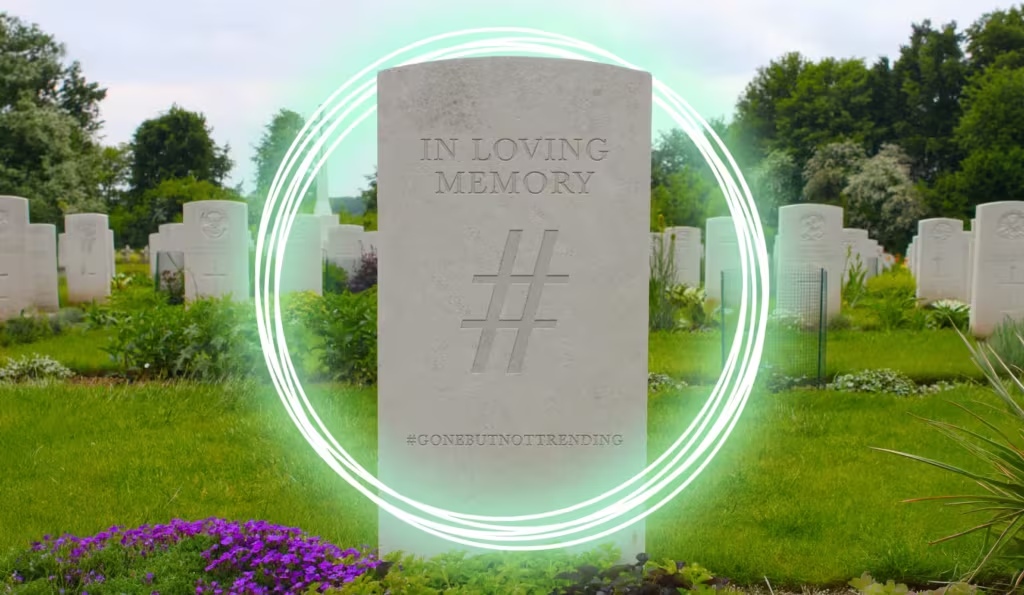
It’s a question that still comes up more often than you’d expect: “Should we be using hashtags on LinkedIn”?
For a long time, the answer felt obvious. Hashtags were seen as essential. You’d add five, maybe ten, and expect them to help your content reach the right audience.
Now, though, that expectation may be slightly… outdated.
Not because hashtags have disappeared completely, but because LinkedIn doesn’t rely on them in the same way anymore. So, what’s the state of hashtags on LinkedIn in 2026? Let’s find out.
Why Hashtags on LinkedIn Feel Like a Thing of the Past
There was a time when it felt like hashtags did a lot of the heavy lifting.
They helped categorise content and gave the algorithms clear signals about what you were posting. They were a key factor in making posts discoverable beyond your immediate network. If you wanted reach, you used hashtags, simple as that.
But LinkedIn isn’t that platform anymore.
Over the past few years, the way content is surfaced has shifted, with LinkedIn now prioritising content relevance and engagement signals over simpler indicators like hashtags. The algorithm has become far more sophisticated, and users have changed how they consume content alongside it.
Put simply, hashtags used to tell LinkedIn what your post was about. Nowadays, it already knows. The platform reads your content and understands context. It picks up on meaning, intent, and relevance in a way that goes far beyond a handful of tagged keywords at the bottom of a post. That means that hashtags have become optional rather than necessary when it comes to determining meaning.
Hashtags were once seen as the way to get discovered on LinkedIn, but they’re now much more of a supporting detail than a driving force.
Not seeing the reach you expected on LinkedIn?
If your content still relies on tactics from a few years ago, it might be time to rethink your approach. We help brands create LinkedIn content that actually gets seen, and resonates with the right audience.
What’s Actually Changed?
This shift didn’t happen overnight; it’s been building for a while.
LinkedIn has moved towards a more intelligent, content-first model. It’s not unique to LinkedIn either. Platforms like Instagram, TikTok, and even Google search have all shifted towards understanding content based on meaning and behaviour, rather than relying on keywords or tags alone.
Recent analysis revleas how LinkedIn now prioritises content relevance and engagement signals over keyword markers like hashtags. Instead of relying on signals like hashtags to categorise posts, the algorithms now analyse the full body of your content. It looks at how people engage with it, and learns from behaviour, not just keywords.
At the same time, user behaviour has changed, too. People aren’t browsing hashtag feeds in the way they once did. They’re not searching for #MarketingTips or #B2BGrowth and scrolling through endless tagged posts.
Instead, most discovery is being driven by algorithmic recommendations in place of tagged content. That’s a big shift. Users are being shown, and engaging with, content that feels relevant to them in the moment: content that speaks clearly, quickly, and directly to what they care about.
It means visibility isn’t driven by how well you’ve tagged your post, it’s driven by how well your message lands. At a basic level, LinkedIn is now looking at how your content performs in its first moments: who engages with it, how quickly, and how meaningful that engagement is. Those early signals then tell the platform whether your post is worth showing to a wider audience.
The Problem With Using Hashtags Like We Did Before
All this isn’t to say that we should abandon hashtags on LinkedIn altogether in 2026. Using hashtags isn’t necessarily a problem, but using them the way we used to can be.
Loading a post with five, ten, or more hashtags doesn’t give you the same advantage it once did. In some cases, it can even work against you. Many users are finding that overusing hashtags can actually reduce reach, as LinkedIn increasingly filters out content that appears overly optimised or spam-like.
In some cases, an excessive number of hashtags can signal to both the algorithm and your audience that you’re relying on outdated tactics to boost visibility. It can also make your content feel forced and unfocused, and in a feed where attention is hard to earn, anything that feels like filler only weakens your message.
Part of the reason this still happens is habit. For years, hashtags were seen as a simple way to increase reach, and that thinking has stuck around. But as the platform has evolved, that habit hasn’t caught up; which is why these older approaches can now do more harm than good.
So… Do Hashtags Still Work on LinkedIn?
The honest answer is yes, just differently. Hashtags haven’t disappeared, they just don’t carry the same weight.
Industry guidance now suggests keeping hashtag use minimal, with most recommendations sitting around three to five per post.
Used sparingly, they can still add a layer of context, and help reinforce what your post is about. But they’re no longer the thing that determines whether your content gets seen.
That role now belongs to your content itself.
The data backs this up.

This pivot matters because it changes how you should approach your content from the ground up. It’s no longer about adding signals at the end; it’s about getting the message right from the beginning.
Multiple studies suggest that posts with 1–3 hashtags see up to 10–15% higher engagement, while posts with five or more often see diminishing returns.
So, if you do use hashtags, keep them relevant, minimal, and aligned with the actual topic of your post. And don’t rely on them to do the heavy lifting, that job belongs to the body of your content.
What to Focus on Instead
If hashtags aren’t the main driver of visibility anymore, what is?
It largely comes down to how clearly and effectively you communicate your message. Content that performs well on LinkedIn now tends to be clear, intentional, and written with a specific audience in mind, not the algorithm.
That starts with being clear about who your content is for, whether that’s a defined buyer persona, a particular audience segment, or a broader target audience. The more precise you are, the easier it is for LinkedIn to understand where your content belongs.
Because if LinkedIn can understand your content, it can match it to the right people. If it’s unclear, it can’t, and you risk your content being shown to the wrong audience, or not being surfaced at all.
That’s where relevance becomes the key signal. Not in the form of hashtags, but in the way your content is written, structured, and positioned. The language you use, the problem you’re addressing, and the audience you’re speaking to all help determine where your content ends up.
That means thinking beyond tactics and focusing on how your content actually lands. Whether it connects, resonates, and gives someone a reason to stop scrolling and pay attention.
In other words, LinkedIn isn’t looking for perfectly optimised posts. It’s looking for content that’s clearly relevant to the right audience, and written in a way that feels human.
Hashtags Aren’t Dead, They’re Just Less Important
It’s easy to frame this as the “end” of hashtags on LinkedIn, but that’s not quite right.
They haven’t disappeared, they’ve just been replaced as the primary signal. Where hashtags once told the platform what your content was about, LinkedIn now works that out for itself. And it does so more accurately than a list of tags ever could.
As LinkedIn continues to evolve, this shift towards content-first visibility is only going to become more pronounced. That’s one of the reasons content strategy matters more than ever.
And it’s why, at KAYBE, we don’t build LinkedIn strategies around tactics like hashtags alone. We focus on how your message lands, who it’s reaching, and what it actually does once it gets there.
Because visibility isn’t something you can bolt on at the end of a post anymore. It has to be built into the message from the start. And that’s the real shift. Visibility on LinkedIn isn’t something you optimise for after the fact, it needs to be something you build into the way you think about content from the start.
Ready to get more from your content?
LinkedIn has changed, and your content strategy needs to keep up. If you want to create posts that cut through, connect, and convert, we’re here to help you make it happen.
Leave your details below, and we’ll be in touch.
