

As a digital marketing agency recently awarded Best Digital Marketing Agency London 2026, we are always looking at what is coming next in paid media. So when the opportunity came up to apply for the beta phase of OpenAI Ads, we applied – and got accepted.
Over the past week, we have been testing the platform, setting up campaigns, building a dedicated ad landing page, and exploring how OpenAI Ads compares with the platforms most marketers already know, such as Google Ads and Meta Ads.
It is still early. The platform is clearly in beta. But there are already some very interesting signs of where paid advertising may be heading.
First Impressions: Familiar, But Much Simpler
If you have used Google Ads, Meta Ads, Bing or Microsoft Ads, or similar platforms, the basic structure will feel familiar. You have campaigns, ad groups, ads, landing pages, budgets, bids, tracking parameters and conversion tracking. So far, so normal.
The difference is that OpenAI Ads feels much, much simpler. There are fewer layers, fewer unnecessary settings, and less of the complexity that often makes other ad platforms difficult to manage, especially for businesses that do not have large in-house marketing teams. That does not mean it is basic. It means the setup process feels more direct.
How Campaign Setup Works
The campaign level is where you set the scene. At the moment, the campaign objective options we have seen are limited to clicks and impressions. Conversion-focused objectives appear to be coming soon, but they are not currently available to us in the beta.
You can also set location targeting, daily budget or campaign budget, start and end date as well as the conversion event for tracking purposes.
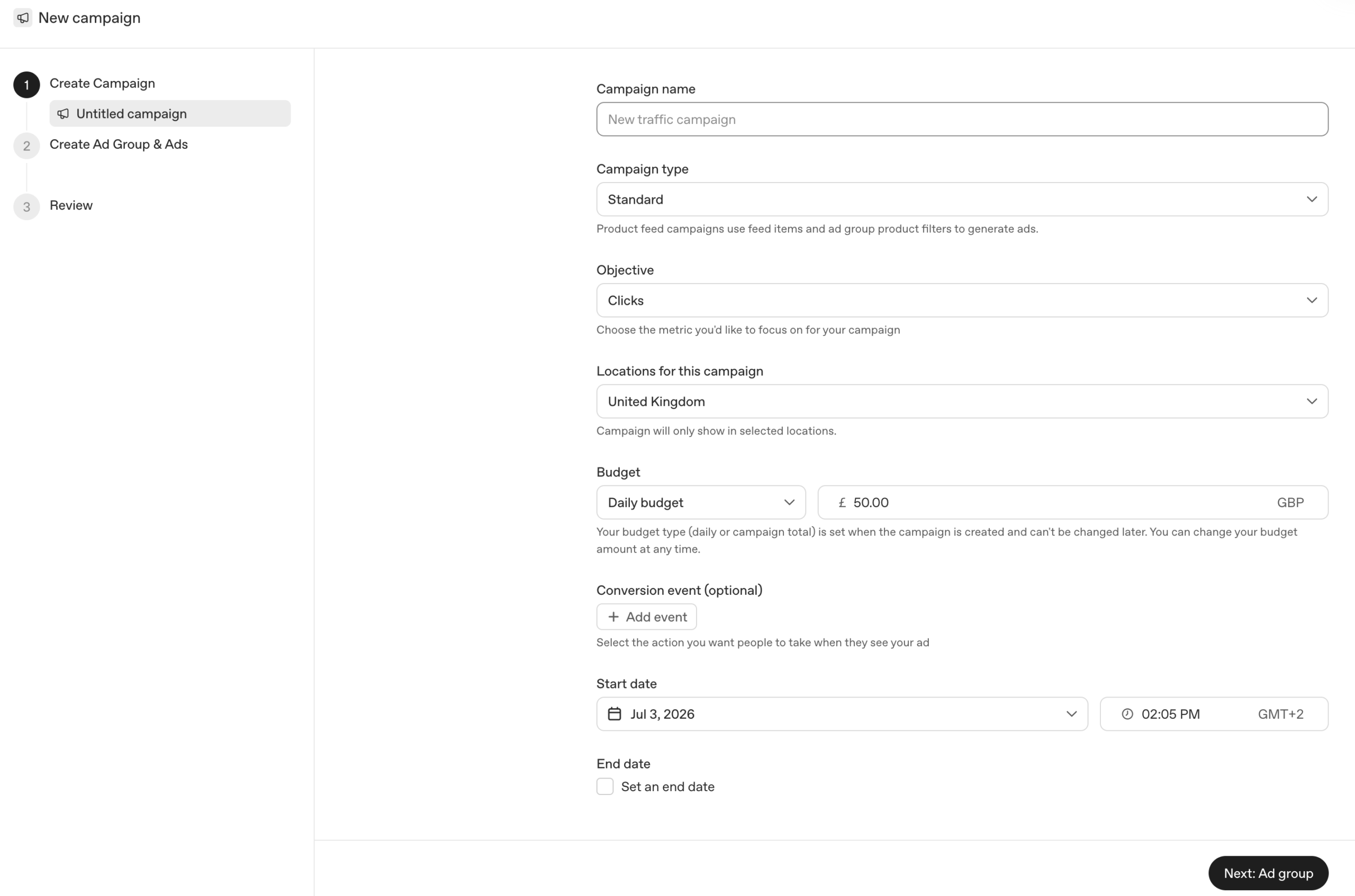
One important note on location targeting: for us, location targeting currently appears to be country-only. We have seen reports that some advertisers may have access to regional targeting, but this is not something we can confirm from our own account so far.
A positive point is budget control. In our first week of testing, we have not seen the kind of daily overspend that can happen on platforms such as Google Ads. The budget appears to be respected more tightly, at least from what we have seen so far.
Ad Groups and Context Hints
For our first test, we structured ad groups around our services. At ad group level, you set your maximum CPC, and the system gives you an indication of whether the bid is likely to be high enough for delivery. This is also where things start to feel different from traditional ad platforms. Instead of selecting from lots of fixed targeting parameters, you provide context hints.
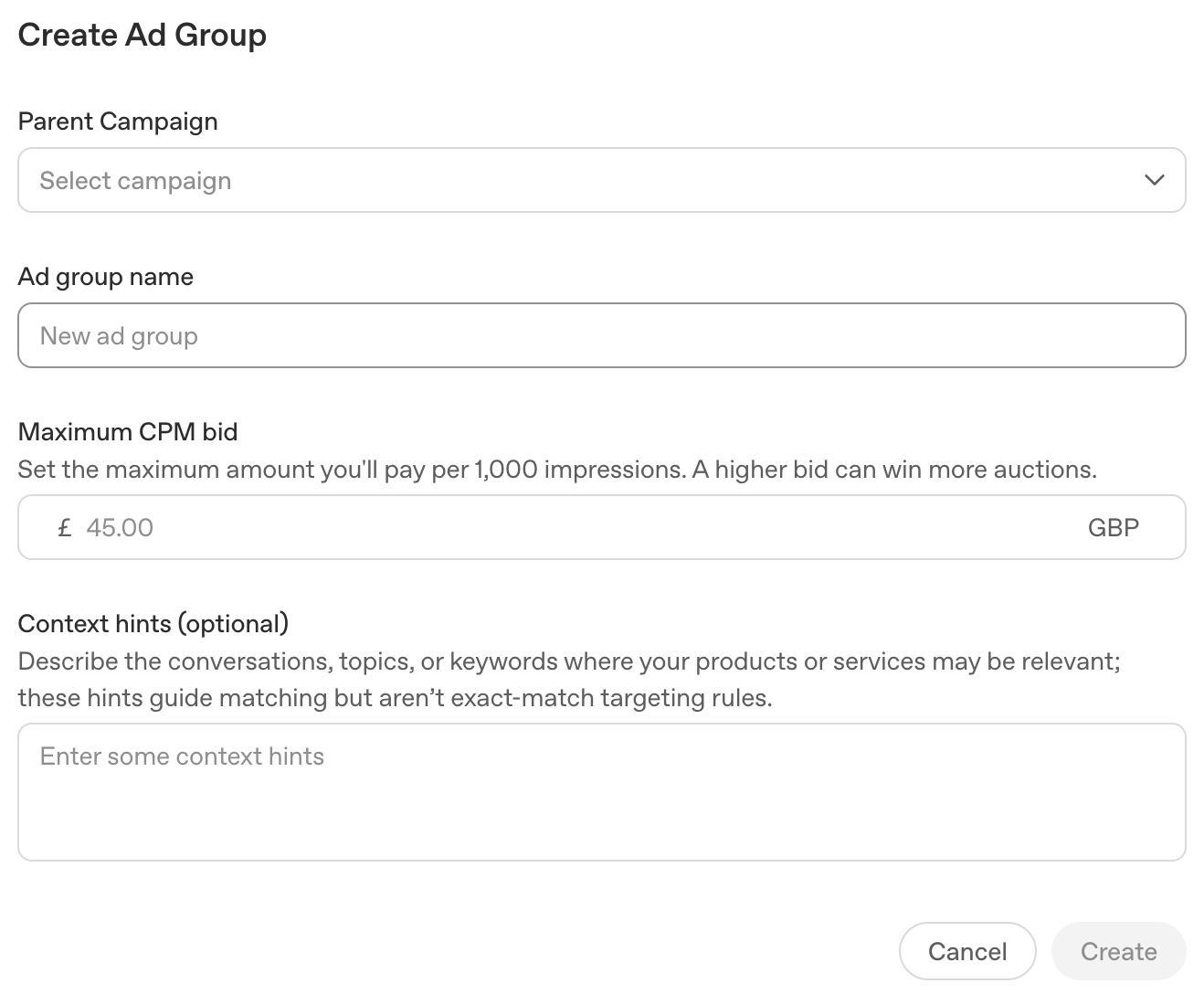
These context hints allow you to describe the kind of situation, user need, problem, intent, or context you want your ads to appear around. And that is where OpenAI Ads becomes very interesting.
Context Hints Are Powerful, But You Need To Be Specific
One of the best things about context hints is that they are not as restrictive as traditional audience targeting. You are not simply choosing from pre-set interests, behaviours, keywords, or demographics. You can explain what you want and what you do not want in plain language. That makes targeting feel more flexible and more natural.
However, there is also a downside: you need to think carefully. You need to consider all angles and be specific enough. It is similar to writing prompts for AI. Most people who have worked with AI have had that moment where the answer goes in a completely unexpected direction and you think, “That is not what I meant at all.”
This also connects closely to a topic our MD, Kris Britton, discussed live on LinkedIn this week: what AI needs before it can be relevant. His point was that it is not always just about the prompt. Yes, the instruction matters, but the data behind it and the judgement applied to it are just as important. AI can only do a great job when it has the right context, enough relevant information, and clear direction on how to interpret that information.
The same principle applies for context hints. If your context hint is too broad, vague, or open to interpretation, the system may understand the opportunity differently from how you intended it. That means advertisers will need to become good at describing intent, context, exclusions, nuance, and desired outcomes. In other words, targeting may become less about clicking boxes and more about combining clear instructions with the right data and human judgement.
Ads Are Matched Contextually
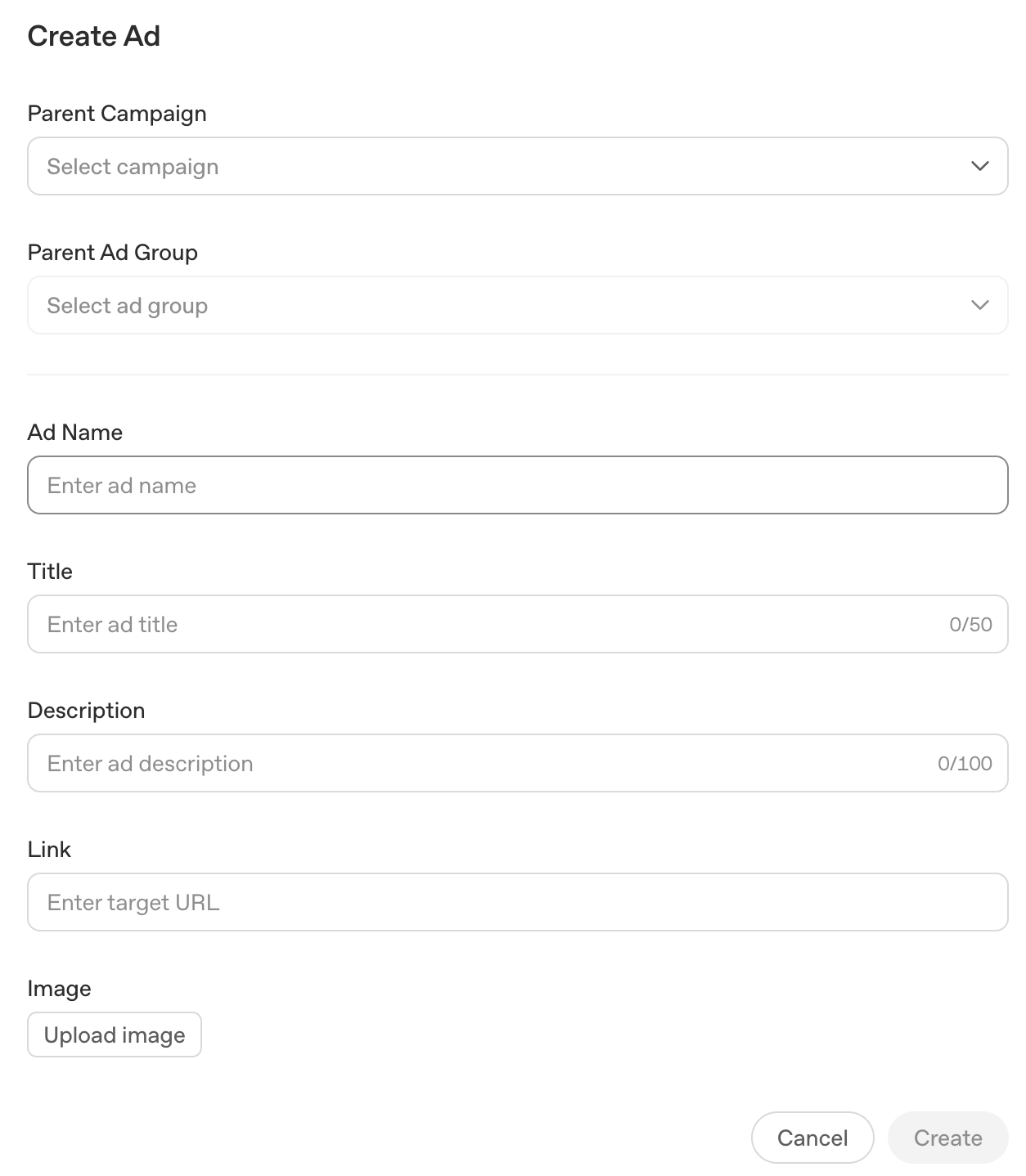
Within each ad group, you can create different ads.
The interesting part is that ads appear to be considered contextually. While the ad group context hint sets the broader scene, OpenAI still assesses the individual ad and whether its topic is relevant to the user. This creates a very different opportunity from traditional keyword or audience targeting.
For example, imagine a product that solves several different problems for the same target audience. Instead of forcing everything into one generic ad, you could create one ad for each problem. Then, depending on what the user is actually asking or trying to solve, the system can show the ad that best fits that specific problem. That has the potential to be much stronger than traditional search ads, where targeting is often limited by the keywords you choose and the intent you assume behind them.
More Personalised Landing Pages
Another feature we like is that every ad can have its own individual URL with parameters included. That makes tracking simpler, but it also opens the door to much more personalisation.
For example, if a user interacts with an ad focused on a specific problem, the landing page can pick up that context and continue the same journey. Instead of sending everyone to the same generic landing page, advertisers can build more relevant experiences based on what the user has just engaged with.
For our first test, we created one ad-specific landing page. Over time, we can see this becoming a major part of OpenAI Ads strategy. The opportunity may not just be in the ad itself, but in how well the landing page continues the conversation.
Early Results From Our First Test
Within the first two days of running the ads, we saw a strong number of impressions and a click-through rate of almost 1%. More importantly, we received one high-value lead from the campaign. Of course, this is still a very small data set. We are not claiming that a couple of days of testing are enough to draw final conclusions. But for a beta platform, the early signs are promising. The traffic is there. Users are engaging. And there is already evidence that the platform can generate meaningful business enquiries.

The Biggest Limitation: Lack of Prompt-Level Insight
The main downside so far is the lack of insight into the actual user prompt or query. As advertisers, we cannot currently see exactly what the user asked before they saw or clicked the ad. That makes optimisation much harder.
On Google Ads, you can review search terms. On Meta, you can analyse audience performance, creative performance, and placement data. With OpenAI Ads, based on what we have seen so far, there is far less visibility into the context behind the traffic.
That means you cannot easily judge the quality of the traffic unless the user converts. This is likely to change over time, but the direction is open and right now it makes campaign optimisation more challenging on an ad level. You have to rely more heavily on downstream behaviour, landing page performance, and conversion data.
OpenAI Ads May Be More About On-Site Optimisation Than Ad Optimisation
That nicely leads to our biggest takeaway so far, which is that OpenAI Ads may shift the focus of optimisation. With Google Ads and Meta Ads, advertisers spend a huge amount of time optimising keywords, audiences, placements, bids, ad copy, and creative. With OpenAI Ads, the ad platform itself currently feels simpler. The bigger opportunity may be in what happens after the click.
That means:
- Creating highly relevant landing pages
- Matching landing page messaging to ad context
- Using tracking parameters properly
- Personalising the user journey
- Measuring lead quality carefully
- Building clear conversion paths
- Testing different problem-led angles
In other words, the winners may not be the advertisers who simply know how to operate the ad platform. The winners may be the advertisers who understand the customer journey best.
Final Thoughts Summarised
OpenAI Ads is still early, and our access is limited to the beta version. Features will change, more options will likely appear, and reporting will likely become more insightful over time. But based on our first week of testing, the platform is already one of the most interesting developments in paid media. It is simpler than many existing ad platforms. It allows more natural context-based targeting. It gives advertisers the chance to create more relevant problem-led ads. And early performance, at least from our first test, has been encouraging. The biggest challenge right now is the lack of visibility into user prompts, which makes optimisation harder than it needs to be.
Still, one thing is clear: advertising inside AI experiences will not work exactly like advertising on search engines or social platforms. It requires a different mindset:
- Less box-ticking. More context.
- Less generic targeting. More precise intent.
- Less focus on the ad alone. More focus on the full journey after the click.
And for digital marketers, that makes this a very exciting space to watch. For brands curious about OpenAI Ads, this is also an opportunity to test the channel early through our beta access. We can support the setup, context hints, tracking and landing page journey, helping you explore the platform with the right structure and expertise from the start.
