


DISCLAIMER: I promise I’m not writing this to persuade my boss not to replace me with a robot. Ok, maybe a bit. But hey, it is interesting. Oh, and this IS NOT an advertisement. We have no association with OpenAI. So, on with the show…
As a content writer, discovering OpenAI’s ChatGPT language model was eye-opening. They’re more commonly known as chatbots, but today we’re discussing the potential use of a ChatGPT content writing system. To see an automated system generating well-written, coherent content could have been concerning. But, actually, it can be a friend to me: an invaluable research asset.We’re talking about something that has scoured every square centimetre of the internet and is waiting to share that information with me. I was so excited when I was first introduced to ChatGPT that my boss, Kris Britton, actually said “I’ve never seen you smile this much before.”
Before we delve any deeper, I should make the point that we’re putting ChatGPT under the microscope because it’s a new, groundbreaking innovation and a giant leap forward in itself field. It is not, however, attempting to be an AI content writing system. We are just looking at its potential future use. So, in this article, we’re going to look at:
- The amazing power of ChatGPT content writing
- The weaknesses and shortcomings of ChatGPT content writing
- Some examples of ChatGPT
This will hopefully clear up any questions you may have about where the technology is now and how it might effect content writers in the future.
The power of ChatGPT content writing
When I asked ChatGPT “What does the future look like for content writers considering ChatGPT’s capability looks to be so advanced?”, the response was that certain specific tasks might be able to become automated and that the future might involve content writers collaborating with the ChatGPT content writing system more often. I, for one, love the idea of working with an AI system to enhance my research; giving me more information on any topic and delivering it much, much faster.
See, instead of reading countless articles to educate myself on a subject, I could potentially rely on AI to do the majority of that reading for me. Statistics, bedrock information and key details can be presented in a digestible format that I can then translate into content that will engage readers. Research is half the battle for content writers, and that’s a researcher’s dream.
Arguably the most impressive feature of ChatGPT, and what sets it apart from similar softwares we’ve seen before, is its ability to adopt the writing voice of existing writers and online content styles (i.e. technical language vs. layman’s terms). As you can see in our JK Rowling example (later in this article), this does take on a degree of cliche and is not a perfect artform, but it does mean anybody is able to generate well-written content in a purposeful, deliberate style.
This could mean that we see businesses attempting to replace content writers by requesting articles on specific topics with specific techniques such as technical language for B2B content, high-SEO content or even specific writers they can trust to deliver what they want. With that said, it simply cannot be effective with the current state of the technology for reasons we’re about to explore.
Shortcomings & limitations
When I discussed this with KAYBE Director & Founder Kris Britton, he seemed very certain that the ChatGPT content writing system could never emulate the ‘human touch’ of a content writer. While I agree that it can’t right now, I’m not entirely convinced that it can’t in the future. Or, at least, I think this is a more complex issue. When this point is made, it conjures up an image of a blandly-written, fact-driven piece of content with absolutely zero emotion.
But ChatGPT’s ability to emulate celebrated writers at your request means it can create emotionally-provocative language. What it can’t currently do, however, is relate to the audience. For example, it can’t describe how impressed I was when I discovered the software by telling you Kris noticed how much I was smiling, nor can it take the temperature of the target audience and write articles in a tone that’s consistent with the current public sentiment.
For the most part, you could be convinced that a ChatGPT-generated article was written by a professional content writer. Unlike what we would’ve seen just a few years ago, the differences are now just subtle areas: the odd sentence here or the brief description there. Additionally, what it cannot do is be original. It can describe the sights & smells of walking down Dublin’s Grafton Street, but only in somebody else’s words. A lack of originality is a limitation for plenty of actual human writers, though, so it’s not to say that would prevent the ChatGPT content writing tool from at least making what would be a decent living (you know, if it was human).
One noteworthy point with ChatGPT’s shortcomings is that it does well to acknowledge its own limitations. For example, when you ask for advice, it will refuse to do so and, if you request information it doesn’t have an in-depth knowledge of (or personal details that should not be shared without the individual’s consent), it will tell you as much. The refusal to provide advice and opinions reduces a very serious concern for many that the ChatGPT content writing tool could help spread unreliable information or even radical ideals.
Examples
Example 1
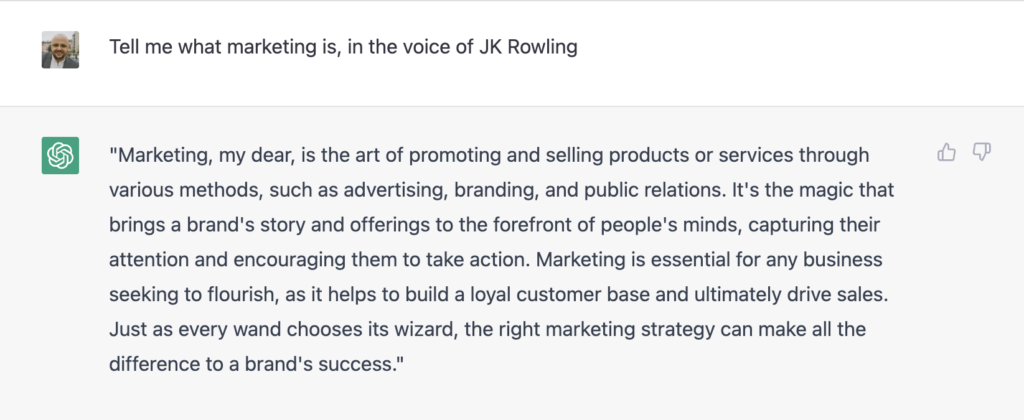
Takeaways: As I mentioned earlier, this is very cliche. Admittedly, it is worth noting that when you search for the style of writers with broader ranges of work (I tried the likes of Stephen King, Oscar Wilde and Ernest Hemmingway across various topics for comparison), this is less of an issue. However, there is a clear voice and you can see that the software has pulled its guiding language from previously-written content without any real self-elaboration.
Example 2

Takeaways: This really, really surprised and impressed me. Firstly, I provided a very open-ended command with absolutely no topic to guide it, yet the system delivered accurately. Secondly, I expected the speech to cut off mid-flow at 150 words, yet it structured the speech to conclude in a polished manner.
Finally, and perhaps most interestingly, it seems to have removed any potential controversies by not including references to either race or religion. While expertly imitating the language and tone of MLK, there’s no mention of Christianity or racial equality, despite these arguably being the main focus of almost all his written and spoken work.
This is not clarified by the software, but I re-tested this theory with a 500-word speech and found the same result, suggesting that this is a deliberate act. This could be very important in alleviating the risk of making it easier for people to spread bigoted or hate-fuelled content.
Example 3
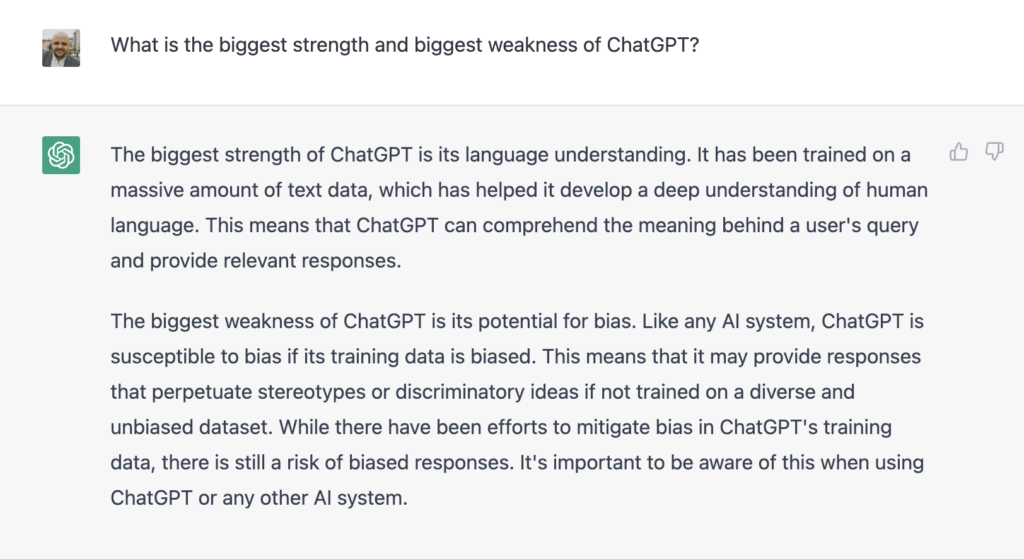
Takeaways: I had to narrow this down to one strength and one weakness as the software wasn’t shy to share both sides of its own coin. As for strengths, I think it’s worth noting that the focus is on responding to queries and there’s no mention of using the tool for AI content writing. As for weaknesses, I find this a bit surprising as it’s something I have already discussed as a strength. However, it is really encouraging to see this degree of self-awareness and responsibility from the developers.
Should I keep my job?
Call me bias, but I’m voting yes. The engineering clearly isn’t yet advanced enough to deliver a ChatGPT content writing software that’s intuitive and original in the way that a content writer must be. In fact, right now, it’s able to help myself and all other content writers improve.
But it’s not just about me. We have a fantastic team at KAYBE, with every individual providing expertise in their field and everybody coming together to work in harmony. We couldn’t possibly achieve what we do without cultivating such an effective environment. You can find out more about what we’re able to do for you by getting in touch with us today.
